Today we’re highlighting one of our saporin conjugates, Anti-CD117-SAP. This is a tool for depleting cells that express CD117, the tyrosine kinase growth factor receptor.
CD117 is expressed on hematopoietic stem cells, mast cells, and acute myeloid leukemia cells. Some of the areas where CD117 plays an essential role is in the regulation of cell survival and proliferation, hematopoiesis, stem cell maintenance and mast cell development, migration and function.
Allogeneic hematopoietic stem cell transplantation can cure genetic diseases such as severe combined immunodeficiency (SCID), but it’s associated with significant toxicities such as graft-versus-host disease (GvHD). Using a patients’ own gene-modified hematopoietic stem and progenitor cells (HSPCs) can eliminate the risk of GvHD, but the treatment relies on gene transfer using viruses and genotoxic conditioning which carries risks.
The authors describe how base-editing is an alternative means to correct genetic defects while engineered virus-like particles (eVLPs) can deliver the base-edited proteins without the risks seen with viral integration.
In conclusion, transplantation of HSPCs that have been repaired through eVLP-mediated base-editing with CD117-ADC conditioning successfully reversed the SCID phenotype in mice, and highlights a significant advancement in disease treatment without the current toxicities.
We are highlighting one of our saporin conjugates, Neurotensin-SAP — a tool for depleting cells that express the neurotensin receptor (NTSR).
Neurotensin is a 13-amino-acid peptide found in the brain and spinal cord and is released by the hypothalamus. It is synthesized as part of a larger precursor protein that also includes the related neuropeptide neuromedin N. Neurotensin affects pituitary hormone release, interacts with the dopaminergic system, and is involved in vasodilation and hypotension. It can also modulate pain perception where intrathecal neurotensin has also been shown to be anti-nociceptive.
The objective was to determine whether NTSR1-expressing enteropancreatic neurons mediate the glucose-lowering effects of dietary olive oil and neurotensin, and to characterize their physiological role in glucose homeostasis.
The authors unilaterally injected neurotensin-SAP into the nodose ganglia to ablate NTSR1-expressing vagal neurons.
In their study, they demonstrated that neurotensin improves glucose tolerance by activating NTSR1-expressing enteropancreatic neurons, which connect the gut and pancreas. Ablation or disruption of these neurons abolished the glucoregulatory effects of both neurotensin and olive oil, establishing their necessity and sufficiency in this pathway.
Cholinergic degeneration in the nucleus basalis of Meynert (NBM) is linked to cognitive impairment and gait dysfunction in Alzheimer’s and Parkinson’s disease. The idea of modeling cholinergic degeneration in an animal model could provide opportunities to study the physiological role of the NBM and lead to new therapeutics.
The authors used a custom-designed cranial chamber implanted to the skull of rhesus monkeys to guide the injection of ME20.4-SAP (IT-15) to deplete cholinergic neurons in the NBM.
After injection, the effects were monitored in vivo using positron emission tomography-computed tomography (PET-CT), which essentially uses small amounts of a radioactive tracer and a special camera and computer to evaluate organ and tissue functions.
Through this work, the authors described an approach that yielded reliable spatial accuracy and delivery of ME20.4-SAP into the NBM.
In conclusion, the selective lesioning of cholinergic neurons in the NBM via ME20.4-SAP offers a promising method to study the pathophysiology of NBM degeneration which can hopefully fuel efforts in creating new therapeutics.
The choroid is a vascular structure that provides nutrients to the photoreceptors as well as the removal of waste from the outer retina, essentially enabling proper retinal function. Loss of the choroid is a crucial pathophysiologic step in a wide range of retinal diseases.
However, a current limitation in developing choroidal cell replacement is the lack of a reliable injury model to allow study of transplantation strategies. Existing models rely on either ablative injury to the choroid with laser photocoagulation but can damage unintended structures or systemic sodium iodate administration, which causes diffuse, progressive choroidal injury.
Authors in this study were able to show that suprachoroidal injection of anti-CD38 and anti-CD105 saporin conjugates resulted in targeted, localized, and non-progressive choroidal injury in rats.
Immunotoxin-based models of targeted choroidal injury may be useful for understanding pathways of retinal degeneration and facilitating the development of therapies for diseases involving choroidal cell loss.
In this study, the authors used Streptavidin-ZAP (IT-27) with biotinylated CD150 antibody to selectively eliminate dysfunctional CD150-expressing hematopoietic stem cells.
Hematopoietic stem cells (HSCs) are specialized cells found in the bone marrow that can develop into all types of blood cells and play a crucial role in maintaining blood tissue and repairing damage throughout a person’s life. However, aging leads to a decline in HSC function, characterized by the accumulation of dysfunctional HSCs and skewed differentiation towards the myeloid lineage which is a component of hematopoietic aging.
Authors were able to show reducing the dysfunctional CD150 HSC population could be a strategy for alleviating aging-related phenotypes in aged mice.
This article is a good example of using saporin conjugates in stem cell research.
Also check out our new catalog product Anti-CD150-SAP (IT-103), which is a direct conjugate of Anti-CD150 and saporin.
Today’s topic is time-course for our saporin conjugates. Common questions we get are (1) how long does it takes to see cell death, (2) how long should I wait before performing histology on an animal, or (3) how long before I see behavioral changes in an animal?
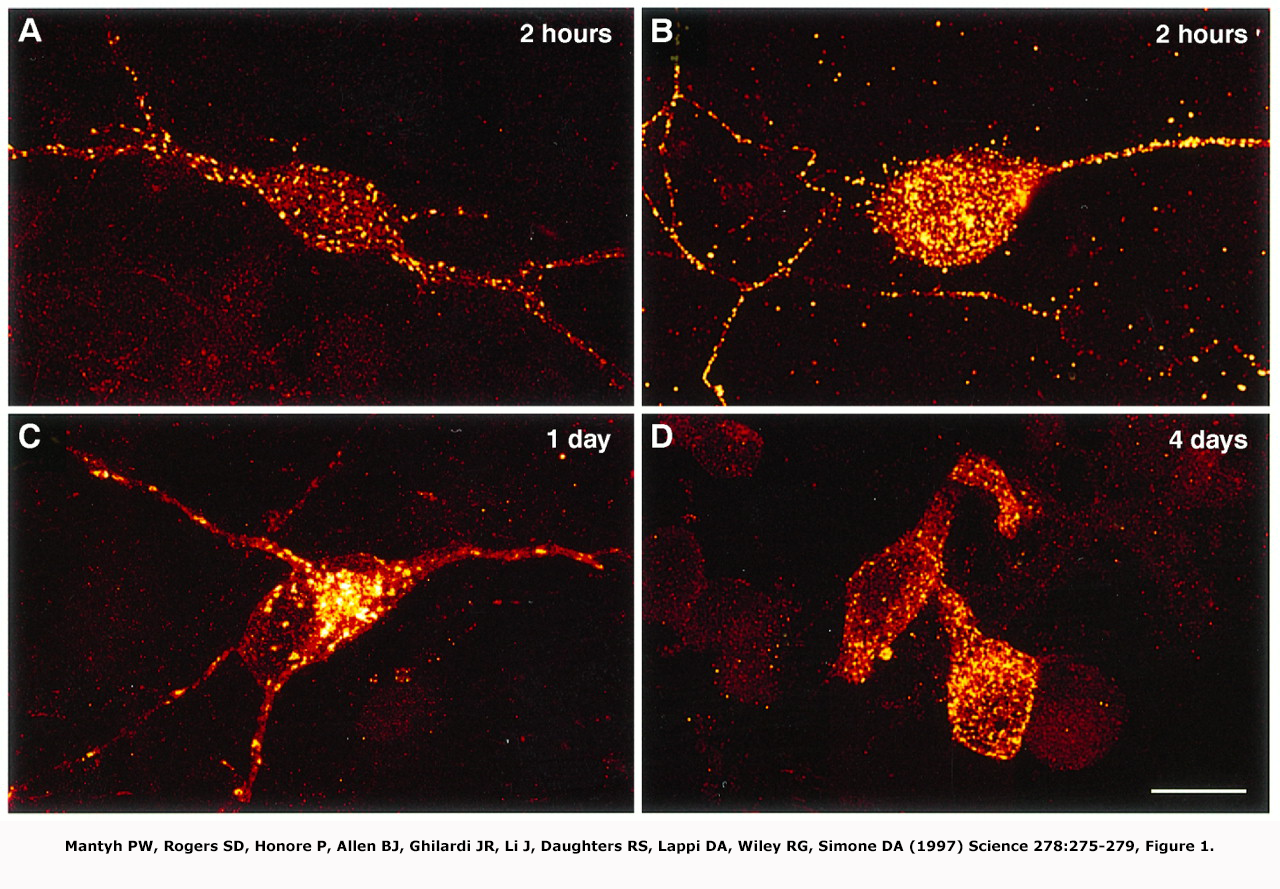
In this image from Mantyh et al. (1997), we are looking at confocal imagery of the binding and internalization of our peptide conjugate SP-SAP to the NK1r receptor in primary cultures of neonatal spinal cord neurons.
As you can see, conjugate binding occurs immediately where within hours, the SP-SAP has recognized and bound to the NK1 receptor. Here we see the areas of concentrated NK1R expression marked by yellow immunofluorescence.
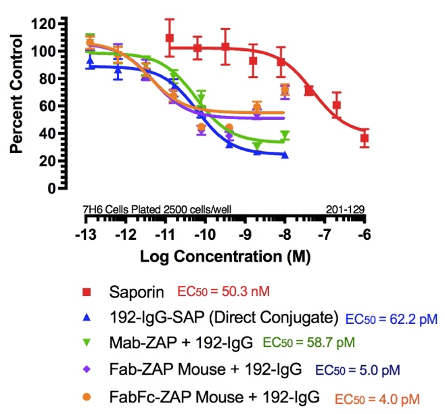
But how long until you see cell death? Here is a cytotoxicity graph of in vitro data of our antibody conjugate 192-IgG-SAP. These are typical data after cells have been treated for 3 days, which is standard protocol.
Waite et al. (1994) used 192-IgG-SAP and showed the appearance of behavioral effects associated with neuronal loss at day four and plateauing at day 7.
This coincides with the time course seen in vitro. At this point, microglia will infiltrate, but stop at 7 days, which is probably the peak day for infiltration. Once there is complete removal of the detritus, microglia down-regulate and at 14 days all debris is cleared and the animal begins to regain normal eating and sleeping habits. This is the idea behind waiting about 2 weeks before performing histology.
ZAP conjugates allow you to screen targeting agents in a quick and cost-efficient way, looking for specificity, functional binding, internalization, and EC50 determination.
Here we have a closer look at the typical in vitro data you can expect to see from a cytotoxicity assay. In this example, you are looking at the cytotoxicity curves using various secondary conjugates when compared to the direct conjugate, 192-IgG-SAP.
Mab-ZAP, our bivalent secondary antibody that recognizes whole IgG, reacted with primary antibody, produces a similar potency to the directly linked conjugate of saporin to the same antibody.
Fab-ZAP and FabFc-ZAP, which both use a monovalent secondary antibody, reacted with primary antibody produced a cytotoxic effect greater than 12-fold over the direct conjugate.
In this example, you will also see an interesting phenomenon with ZAP secondary conjugates. It may be intuitive to think that using a higher dose of primary antibody induces a higher amount of cell death, but at the highest concentration of 192-IgG (10 nM = Log (-8)) there is a lessened amount of killing, at a 25-fold lower concentration when compared to the antibody. The explanation is that at the higher concentrations of primary antibody, there are more unconjugated 192-IgG and fewer 192-IgG plus Fab-ZAP complexes. So, this free 192-IgG can then out-compete the conjugates for cell surface binding sites, which, in turn, decreases the amount of saporin being internalized, hence less cell death.
Our publication in the Journal of Toxins, provides a nice review of this phenomenon.
We are continuing to highlight our ZAP antibody internalization kits and our line of secondary antibody saporin conjugates.
ZAP conjugates allow you to screen targeting agents in a quick and cost-efficient way, looking for specificity, functional binding, internalization, and EC50 determination.
We also highlighted a publication that did a great job in showcasing how they can be used to screen antibodies for the best candidate, and then proceed with having us perform a custom conjugation of that antibody directly to saporin.
Here is information about the chemistry and why we offer conjugates that use whole, bivalent, IgG as well as monovalent Fab IgG.
Our first release of ZAP conjugates utilized whole-molecule IgG, bivalent secondary antibodies that recognized both heavy and light chains of primary antibodies. In theory though, this presented a possible limitation if the bivalent nature of an antibody suggested that cross-linking could occur on the cell surface and contribute to a phenomenon known as ‘cap formation’. The ‘cap’ could potentially induce some level of endocytosis that would lead to cytotoxicity and produce a false positive for internalization of a primary antibody.
We designed new secondary conjugates (given the moniker Fab-ZAP) which used monovalent antibodies that would continue to recognize whole IgG, but lacked components that would contribute to capping.
We now offer 3 main categories: (1) Conjugates made with bivalent antibodies that recognize whole IgG, (2) conjugates made with monovalent antibodies that recognize whole IgG, and (3) conjugates made with monovalent antibodies that recognize only the Fc region of IgG.
We are highlighting our ZAP antibody internalization kits, as well as our line of secondary antibody saporin conjugates. These products are given the moniker “ZAP”in place of saporin.
The ZAP conjugates produced by ATS consist of a variety of secondary antibodies that allow a large number of targeting agents to be screened quickly and cost-efficiently for specificity, functional binding, internalization, and EC50 determination.
The conjugates are constructed using either species-specific secondary antibodies, or streptavidin (for use with biotinylated Targeting Agents), and they are chemically attached to Saporin, a potent plant ribosome-inactivating protein.
Use of a ZAP conjugate eliminates the time-consuming and expensive step of conjugating each targeting-agent-candidate to the payload. The ZAP conjugate can simply be reacted with a targeting agent in a single step and added to cells in culture conditions.
Once the reacted conjugate has been administered, the Targeting Agent seeks out and binds its receptor and takes the saporin payload inside the cells of interest, where it is released within the cytosol to inactivate the ribosomes. Cells that don’t express the target cell surface marker don’t bind or internalize the ZAP-targeting agent complex, and won’t be affected. Saporin has no binding chain, and no means of getting into cells on its own.
Our line of pHast conjugates are one of the fastest tools to quantitatively test your primary antibody’s specificity, binding, and internalization, providing results in 1 day.
The pHast conjugate uses a secondary antibody that is cross-linked to a pH-dependent fluorescent reporter and will piggy-back onto your primary antibody. This fluorescent reporter will increase intensity as the pH of its surroundings becomes more acidic, such as you would see on the inside of a cell.
Our pHast conjugates can recognize and bind to various species, such as human, mouse, rat, rabbit, goat, guinea pig, chicken, and the newest arrivals are the conjugates that can bind to VHH domain, typically seen in heavy chain in alpaca IgG.
We also offer streptavidin conjugated to our pHast dyes which opens up the choice to use a biotinylated targeting agent.
Not only do we offer various species for targeting, but we also offer various pH dependent fluorescent dyes, allowing you to multiplex in the same experiment.