
- ZAP conjugates allow you to screen targeting agents in a quick and cost-efficient way, looking for specificity, functional binding, internalization, and EC50 determination.
- Here we have a closer look at the typical in vitro data you can expect to see from a cytotoxicity assay. In this example, you are looking at the cytotoxicity curves using various secondary conjugates when compared to the direct conjugate, 192-IgG-SAP.
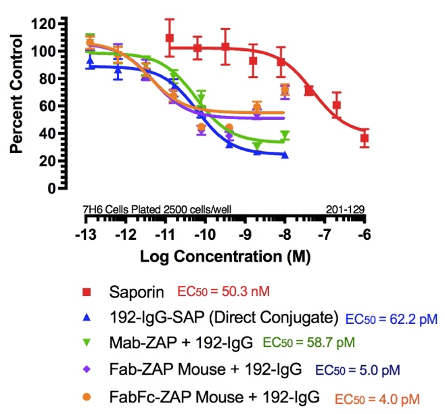
- Mab-ZAP, our bivalent secondary antibody that recognizes whole IgG, reacted with primary antibody, produces a similar potency to the directly linked conjugate of saporin to the same antibody.
- Fab-ZAP and FabFc-ZAP, which both use a monovalent secondary antibody, reacted with primary antibody produced a cytotoxic effect greater than 12-fold over the direct conjugate.
- In this example, you will also see an interesting phenomenon with ZAP secondary conjugates. It may be intuitive to think that using a higher dose of primary antibody induces a higher amount of cell death, but at the highest concentration of 192-IgG (10 nM = Log (-8)) there is a lessened amount of killing, at a 25-fold lower concentration when compared to the antibody. The explanation is that at the higher concentrations of primary antibody, there are more unconjugated 192-IgG and fewer 192-IgG plus Fab-ZAP complexes. So, this free 192-IgG can then out-compete the conjugates for cell surface binding sites, which, in turn, decreases the amount of saporin being internalized, hence less cell death.
- Our publication in the Journal of Toxins, provides a nice review of this phenomenon.
episode26, episode48