FAQ

Frequently asked questions and answers for ATS products and services.
116 entries

Using Kit Controls

Q: Your targeted toxin kits come with different controls. I’m not sure of the best way to use them; there is included unconjugated antibody, unconjugated saporin, and a control conjugate, mouse IgG-SAP. Should I use them all in the same experiment or for different purposes?

A: For mouse IgG-containing conjugates, the ideal control is Mouse IgG-SAP (Cat. # IT-18). Mouse IgG-SAP — that is, saporin conjugated to mouse IgG — that has no specific antigen for targeting is the best control. Unconjugated saporin is still considered a second good control, useful in cases where down-regulation by the antibody is a concern.

Q: What about for the peptide toxins?

A: We have produced Blank-SAP as a control for the peptide ligand toxins. Blank-SAP (Cat. #IT-21) is a peptide that has the usual common amino acids that are found in peptide neurotransmitters, but arranged in a sequence that is random and not detected in homology searches. So, it should never find an amenable receptor.  This is quite an important control; the peptide ligand toxins are often delivered directly to tissue, and there are cases in which there will be no toxicity or non-specific toxicity.

One of the best uses we have seen for Blank-SAP has been in: Bugarith K et al. Basomedial hypothalamic injections of neuropeptide Y conjugated to saporin selectively disrupt hypothalamic controls of food intake. Endocrinology 146(3):1179-1191, 2005.

As any journal reviewer will tell you, it’s very important to document the specificity, and with Blank-SAP as a control, you can definitively show that toxicity is due to proper targeting, rather than non-specific cytotoxicity. This should provide the information needed so the reviewer doesn’t have to make you go back and document specificity with further experimental work!

See a complete list of control conjugates here.

Which secondary ZAP conjugate should I use?

Q: I’ve been looking at your secondary conjugates and want to see if my targeting agent is specific to certain cells. Which secondary conjugate should I use?

A: It depends on two factors: 1) the type of assay you want to use, and 2) the kind of targeting agent you want to use.

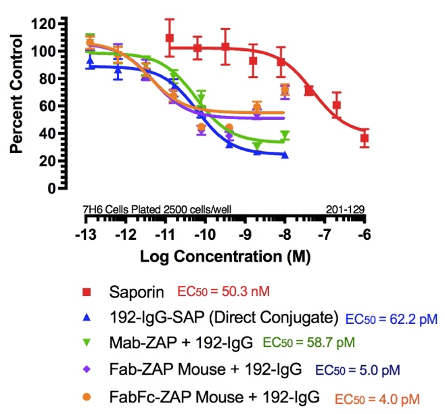
For in vitro assays, in particular, internalization assays, you can use any of the ZAP Antibody Internalization Kits (Z-Kits that include all the materials necessary to test your targeting agent).

For the Antibody Internalization Kits, you use your primary antibody and select the appropriate secondary antibody species, depending on the isotype of your primary antibody — e.g. for a human antibody, use Hum-ZAP (Cat. #KIT-22-Z), Fab-ZAP human (Cat. #KIT-51-Z), FabFc-Human (Cat. #KIT-65-Z), Hug-M-ZAP (Cat. #KIT-43-Z), or Fab-ZAP Hug-M (Cat. #KIT-78-Z).

Or you can biotinylate your antibody and use Biotin-Z Antibody Internalization Kit (Cat. #KIT-27-Z).

For in vivo applications, it depends on the kind of targeting agent you want to use. Regardless of whether you use an antibody, peptide or ligand, you will need to biotinylate the material first. ATS offers a biotinylation service that is efficient and economical.

If you are using a biotinylated peptide, you will use a kit that includes the appropriate control — Streptavidin-ZAP Peptide Kit (Cat. #KIT-27-B).

If you are using a biotinylated antibody, you will use the Streptavidin-ZAP Antibody Kit that includes the appropriate antibody species control: BIgG-SAP Human (Cat. #KIT-27-Ahu), BIgG-SAP Mouse (Cat. #KIT-27-Amu), BIgG-SAP Rabbit (Cat. #KIT-27-Arb), BIgG-SAP Rat (Cat. #KIT-27-Art). Select the kit that matches the species of your biotinylated primary antibody.

Related: ZAP Secondary Conjugates

Saporin Safety

Over the years, ATS has frequently been asked about Saporin’s safety for use in the lab as well as when used clinically. Residual awareness of alternate Ribosome-Inactivating Proteins (RIPs) and ‘toxins’ such as Ricin have caused some researchers new to the use of RIPs to question the belief that Saporin is safe. Unlike Type 2 RIPs (such as Ricin), Type I RIPs, like Saporin have no binding chain and consequently no means of entering the physiological space necessary for the protein to act as a toxin. The following is a review of safety in handling and potential toxicity within the human body for systemic events not related to normal research applications of Saporin conjugates, including Substance P-Saporin (SP-SAP), which is a therapeutic under development for the treatment of chronic pain.

The acute LD50 for saporin in mice (25 g) is 6.8 mg/kg;[1] that would translate in humans (75 kg) to 510 mg! A concentration of about 100 nM is the threshold to see even a vague hint of saporin toxicity. In human blood, that would correspond to 24 mg injected systemically into a person. The fermentation process to produce recombinant saporin has a titer of 2 mg/L meaning that the production broth itself contains no more than 67 nM concentration of saporin. Furthermore, the final protein concentrations from production batches of recombinant Saporin used in our drug are 4 mg/ml, meaning 6 mL of final material would need to accidentally end up in a human before the ‘hint of toxicity’ threshold would potentially be met.

The toxicology studies of SP-SAP contained within ATS’s IND prior to the current human Phase I clinical trial evaluated effects related to the intended method of administration, intrathecal local injection. SP-SAP is not expected to ever be a self-administered therapy, so the effects of gross off-target events, such as accidental auto-injection, swallowing, spillage, or immersion were not considered.

The table below[2] highlights antibody-saporin conjugates approved by the FDA for Phase I/II clinical trials in humans. The therapeutics listed below were administered intravenously and imply what the FDA accepted as non-toxic levels of saporin-based conjugates in these studies.

Looking more closely at the study by French et al.,[3] several milligrams of antibody conjugate were repeatedly injected into human patients under a FDA regulated clinical trial and peak serum levels tested, demonstrating rapid clearing of saporin from the system.

As a company that specializes in Saporin, our two-plus decades of experience working with the protein in research, preclinical, and clinical environments has taught us that with minimal standard laboratory precautions users are not at any real risk of toxic effects. Even our CSO, after 30+ years of working with Saporin exhibits undetectable levels of Saporin antibodies in his blood!

References:

  1. Thorpe PE et al. An immunotoxin composed of monoclonal anti-thy 1.1 antibody and a ribosome-inactivating protein from Saponaria officinalis: potent antitumor effects in vitro and in vivo. J Natl Cancer Inst 75:151-159, 1985.
  2. Polito L et al. Immunotoxins and other conjugates containing saporin-s6 for cancer therapy. Toxins (Basel) 3(6):697-720, 2011.
  3. French RR et al. Response of B-cell lymphoma to a combination of bispecific antibodies and saporin. Leuk Res 20(7):607-17, 1996.

Safety of the Toxin

Q: Our QA group wants to know about the safety of the toxin in your conjugates. What precautions should we take in handling saporin products?

A: Saporin is a Type 1 ribosome-inactivating protein (RIP), due to its N-glycosidase activity, from the seeds of Saponaria officinalis. It was first described by Fiorenzo Stirpe and his colleagues in 1983 in an article that illustrated the unusual stability of the protein.[1] Among the RIPs are some of the most toxic molecules known, including ricin and abrin (the latter is the poison preferred by the characters in the movie The Blue Lagoon). These toxins contain a second protein strand that inserts the RIP into a cell, making it able to enzymatically inactivate the ribosomes, shutting down protein synthesis and resulting in cell death and eventually causing death of the victim.

Saporin does not possess a cell-binding chain[2] and has no method of internalization without a targeting agent to escort it into a cell. It is this fact that also adds to the safety of its use in the lab. Autoclaving or exposure to 0.2 M NaOH is sufficient to decontaminate material that has been in contact with Saporin and its conjugates. The LD50 for Saporin in mice is 4-8 mg/kg.[3] With an average person, let’s say 75 kg, that would be more than what you might have in your freezer, let alone be able to inject in yourself. Targeted Saporin, if targeted to a human epitope, should be handled more carefully, but due to logistics, it’s difficult to imagine an effect.  Hundreds of articles in the scientific literature (search “Saporin” in Pub Med) have demonstrated tremendous specificity in targeting neuronal cells with many different Saporin conjugates and by many different scientists.

References

  1. Stirpe F et al. Ribosome-inactivating proteins from the seeds of Saponaria officinalis L. (soapwort) of Agrostemma githago L. (corn cockle) and of Asparagus officinalis (asparagus) and from the latex of Hura crepitans L. (sandbox tree). Biochem J 216:617-625, 1983.
  2. Barthelemy I et al. The expression of saporin, a ribosome-inactivating protein from the plant Saponaria officinalis, in Escherichia coli. J Biol Chem 268(9):6541-6548, 1993.
  3. Stirpe F et al. Hepatotoxicity of immunotoxins made with saporin, a ribosome-inactivating protein from Saponaria officinalis. Virchows Arch B Cell Pathol Incl Mol Pathol 53(5):259-271, 1987.

Retrograde Transport

Q: I’m trying to find out if enough Anti-DBH-SAP will be retrogradely transported and taken up by non targeted sympathetic neurons by bulk fluid-phase endocytosis. Does saporin become degraded after it kills the neuron or does it enter the extracellular matrix?

A: It is very unlikely that a targeted toxin such as Anti-DBH-SAP is freed from the targeted neuron in a meaningful condition. There has never been a reported identification of a targeted toxin, functionally or not, after it has eliminated its targeted neuron. Current evidence indicates that effective suicide transport agents undergo endocytosis at nerve terminals followed by retrograde axonal transport of the endocytic vesicles containing the toxin. Experiments using vincristine have shown that the retrograde axonal transport of suicide transport toxins utilizes the fast transport system (microtubules). However, it is not known what determines whether or not a specific toxin-ligand undergoes axonal transport after internalization.

Related Products: Anti-DBH-SAP (Cat. #IT-03)

in vitro Cytotoxicity Assays

Q: For in vitro cytotoxicity assays, could you tell me: 1) whether you incubate primary with your Saporin secondary for a specific amount of time prior to cell addition, and 2) do you use a single concentration of secondary per well or a primary:secondary ratio — like 1:2 or 1:4?

A: The primary antibody should be incubated with the ZAP product for 20 min prior to addition to the cells. Internalization often happens so quickly that you would lose some efficacy due to the antibody being bound and internalized prior to the ZAP product complexing with the primary. We do recommend maintaining a constant 5 nM (~ 45 ng/well) concentration of the ZAP product in the well and titrating your primary only. This way the EC50 you generate will be the EC50 of the primary antibody with all else held constant. The best starting concentration for your primary antibody is 10-100 nM in the well.

Related Products: ZAP Conjugates

Targeted Toxin Format

Q: I ordered a targeted toxin. Will it come in powder form? How do I re-dissolve it?

A: Our Saporin conjugate products are all provided in sterile PBS solution within a concentration range of 0.5 – 3 mg/ml. Saporin is an extremely safe ‘toxin’ to handle in standard laboratory environments when in solution for several reasons. Solutions in general are easier to corral and keep contained than powders and consequently are less likely to accidentally end up on an individual’s skin, tongue, or in one’s eyes. As a lyophilized product, Saporin would also be present at an extremely high concentration such that there is cause for concern should it contact the body of the user in any way. Lastly, our Saporin conjugates have historically required dilution prior to use for both in vitro and in vivo procedures. As such, it is much easier to ensure the amount of material you, as a customer, are receiving and the subsequent dilution is accurately adjusted to your desired concentration when providing these products already in solution. If upon receiving a Saporin conjugate you believe the product to be lyophilized or in a powder form, please contact us immediately, prior to opening the vial.

Related Products: Targeted Toxins

Anti-DBH-SAP specificity

Q: I’m interested in your anti-DBH-saporin toxin for lesioning central catecholaminergic neurons. I see from the product description that the antibody used is a mouse monoclonal – designed to specifically target rat DBH. My interest is to produce targeted lesions in mouse transgenic. Will this product still work specifically? Thanks.

A: Unfortunately, we do not have really good data to support the use of our Anti-DBH-SAP (Cat. #IT-03) in mice. There is significant homology between mouse and rat DBH, however the actual antigen for both the mouse monoclonal we use in the immunotoxin and an alternate unpurified rabbit polyclonal, is native bovine DBH enzyme. For further background information there are two references where our product was used in mice. The references are listed below.

An early sympathetic nervous system influence exacerbates collagen-induced arthritis via CD4+ / CD25+ cells.[1] The sympathetic nervous system can play conflicting roles in collagen-induced arthritis (CIA). CD4+CD25+ T cells can play an immunoregulatory effect in this system depending on the expression of the FoxP3 transcription factor. Mice received 5-µg intraperitoneal injections of anti-DBH-SAP to induce an early sympathectomy. The results indicate that the sympathetic nervous system increases disease severity in CIA by stimulating some of the proinflammatory aspects of CD4+CD25+ T cells.

An opposing time-dependent immune-modulating effect of the sympathetic nervous system conferred by altering the cytokine profile in the local lymph nodes and spleen of mice with type II collagen-induced arthritis.[2] In this work the authors examined the role of the sympathetic nervous system (SNS) in late stages of chronic arthritis. 5 µg intraperitoneal injections of anti-DBH-SAP in mice were used to confirm that previous 6-OHDA injections caused a sympathectomy. The results demonstrate that the SNS supports inflammation during the asymptomatic phase of arthritis, but inhibits inflammation during the chronic symptomatic phase.

Related Products: Anti-DBH-SAP (Cat. #IT-03)

References

  1. Harle P et al. An early sympathetic nervous system influence exacerbates collagen-induced arthritis via CD4+CD25+ cells. Arthritis Rheum 58:2347-2355, 2008.
  2. Harle P et al. An opposing time-dependent immune-modulating effect of the sympathetic nervous system conferred by altering the cytokine profile in the local lymph nodes and spleen of mice with type II collagen-induced arthritis. Arthritis Rheum 52:1305-1313, 2005.

Intrathecal Injections and Dosage

Q: Our lab is getting ready to begin a project using one of your targeted toxins. We already did a preliminary experiment to try out the material, but we have a couple of questions before we start the larger project. First, do you have any protocols or references for injecting intrathecally?

A: Thank you for your inquiry. We appreciate the opportunity to get involved in projects before they begin. At Advanced Targeting Systems, we do not do any in vivo work, just in vitro, however we have collaborated with many fine laboratories that have good experience with intrathecal injections. If you search PubMed with the keywords ‘saporin’ and ‘intrathecal’ you will be able to view references that will give you good information on techniques and protocols. Prior to beginning your project you will want to submit your animal care guidelines to your IACUC committee. Turner et al. published an article that will be helpful regarding intrathecal injections. [1]

Q: The second question is in two parts: 1) how do we determine the appropriate dose, and 2) how do we know saporin is not killing indiscriminately at that dose?

A: You should always use a control when determining the appropriate dose. A basic premise of the ATS targeting technology is that if a control (saporin alone or a control conjugate) evokes a response, then the dose is too high. Whenever a new shipment of targeted toxin is received, the proper working dilution should be ascertained before beginning a project. The targeted toxin data sheet states:

“There may be lot-to-lot variation in material; working dilutions must be determined by end user. If this is a new lot, assess the proper working dilution before beginning a full experimental protocol.”

If you search on the ATS website for the species and route of administration you plan to use, you can look through the publication summaries and see the dose that was used for that particular study. That will give you a ballpark range in which to start your dose titration. Just keep in mind: if the control kills cells, the dose is too high.

References

  1. Turner et al. Administration of Substances to Laboratory Animals: Routes of Administration and Factors to Consider. J Am Assoc Lab Anim Sci 50(5): 600–613, 2011.

ZAP Kit Sizes

Q: I have been using your ZAP Antibody Internalization Kit. It is working well for me, but I can only test one antibody at a time. Do you offer the ZAP kit in larger sizes?

A: We do offer kits with sufficient components to test multiple antibody candidates. We offer “Z4” and “Z10” sizes of kits that include all of the same consumable components of the original ZAP kit in quantities sufficient to test 4 or 10 antibodies, respectively. While the included recommended protocol is identical to the original ZAP kit, the added materials provide an opportunity for the experienced researcher to streamline their experiment by testing multiple antibody candidates at one time.

Related Products: ZAP Conjugates

Shopping Cart
Scroll to Top