FAQ

Frequently asked questions and answers for ATS products and services.
116 entries

Activation of p75 receptor

Q: I have a few questions about the Alexa488-labeled affinity-purified NGFr antibody (Cat. #AB-N43-FLA). Is it specific to extracellular p75? Can you use it on live cells? Does it work on fixed cells? Does it cause activation of the p75 receptor (i.e., result in apoptosis or changes in axon outgrowth in neuronal cells)?

A: This product does recognize extracellular p75 in both live and fixed cells. As for the activation, that’s an interesting question. There is no evidence of 192-IgG either causing apoptosis or neurite outgrowth as far as I can see. Chandler et al. (1984) report that the antibody “partially inhibits the regeneration of neurites from primed PC12 cells,” and it enhances NGF binding. But that’s about it, despite several studies being done with PC12 cells and in vivo. We assume all this holds upon treatment with 192-IgG-SAP (Cat. #IT-01) — until the cell dies from saporin poisoning.

Chandler CE, Parsons LM, Hosang M, Shooter EM (1984) A monoclonal antibody modulates the interaction of nerve growth factor with PC12 cells. J Biol Chem 259(11):6882-6889.

Related: NGFR (192-IgG, p75) Mouse Monoclonal, Alexa488-labeled (Cat. #AB-N43-FLA)

Intrastriatal Administration

Q: Is there is any indication that intrastriatal administration of 192-IgG-SAP (Cat. #IT-01) will lesion the cholinergic neurons of the striatum. My sense from reviewing the literature is that these cholinergic neurons are not susceptible to the toxin, but I thought I’d ask to see if you had any information / experience regarding this point.

A: No, I don’t think it will work because the target of 192-IgG-SAP is p75, LNGFr, which is only expressed on the rat basal forebrain cholinergic neurons. Those striatal neurons don’t express p75 in the adult. The NK1r is often expressed in the striatum, and you can use SSP-SAP (Cat. #IT-11) for them, but that’s the best we can do right now.

Related: 192-IgG-SAP (Cat. #IT-01), SSP-SAP (Cat. #IT-11)

Targeted Toxin Disposal

Q: Your targeted toxin data sheet gives the following instruction for disposal: “Care in disposal is mandatory; autoclaving or exposure to 1 M sodium hydroxide will inactivate the material. All labware that comes into contact with this material should be likewise treated.” I am wondering if I can deactivate saporin by using 10% bleach or if everything has to be autoclaved?

A: Yes, you can use bleach to deactivate saporin prior to disposal or reuse of labware. If you are using nanogram quantities, these are too low to be toxic, so you can discard as you do your other non-hazardous laboratory materials without fear.

Related: Targeted Toxins

Agonist Effects

Q: Do conjugated toxins (dermorphin-saporin in particular) exhibit agonist effects? I’ve generated behavioral and tissue time course effects but have not established agonist effects for this conjugated toxin.

A: The peptide ligand toxins should exhibit agonist effects. They are constructed purposely to retain complete agonist activity, including for us the most important: internalization. So, for instance, SP-SAP (Cat. #IT-07) causes receptor internalization similar to SP, as reported in Mantyh et al.

As to dermorphin-SAP (Cat. #IT-12) specifically, it has agonist activity very much like dermorphin. This is reported in Porreca et al. in which it’s stated:

The bilateral microinjection of 3 pmol of dermorphin or of dermorphin-saporin directly into the RVM produced a robust antinociceptive effect in the 52°C hot-water tail-flick test. The peak antinociceptive effect of dermorphin, 78 ± 13.2% MPE, was not significantly different from that of the dermorphin-saporin conjugate, which was 59 ± 4.7% MPE (p > 0.5, Student’s t test).

Usually the amount needed to give a response is lower than the amount needed to kill a cell. Depending on what your system is; it may be a peculiarity of that system, but I would be a little concerned about not seeing an agonist effect. On the other hand, if you have demonstration of specific toxicity, it may not be all that crucial.

See: Targeted Toxins

Targeted Toxin Controls

Q: Your targeted toxin kits come with different controls. I’m not sure of the best way to use them. For example, with the anti-SERT-SAP kit (Cat. # KIT-23) there is included unconjugated antibody, unconjugated saporin, and a control conjugate, mouse IgG-SAP. Should I use them all in the same experiment or for different purposes?

A: Yes, perhaps we do have a few too many options for controls; better too many than too few. For anti-SERT-SAP, the ideal control is mouse IgG-SAP (Cat. # IT-18). Anti-SERT-SAP is made from saporin conjugated to a mouse monoclonal IgG that has SERT as its antigen. So, mouse IgG-SAP – that is, saporin conjugated to mouse IgG that has no specific antigen for targeting – would be the best control, in my mind. For years, the unconjugated antibody and unconjugated saporin mixed together was the best control available (until we came out with the “irrelevant” control immunotoxins), and still might be considered a second good control, or useful in cases where down-regulation by the antibody is a concern.

Q: What about for the peptide toxins like orexin-SAP (Cat. # IT-20) or SP-SAP (Cat. #IT-07)— what controls are available for those?

A: We have produced Blank-SAP as a control for the peptide ligand toxins. Blank-SAP (Cat. #IT-21) is a peptide that has the usual common amino acids that are found in peptide neurotransmitters, but arranged in a sequence that is random and not detected in homology searches. So, it’s like shooting blanks; it should never find an amenable receptor. This is quite an important control; the peptide ligand toxins are often delivered directly to tissue, and there are cases in which there will be no toxicity or non-specific toxicity. The best use we have seen for Blank-SAP has been in Bugarith et al. As any journal reviewer will tell you, it’s very important to document the specificity, and with Blank-SAP as a control, you can definitively show that toxicity is due to proper targeting, rather than non-specific cytotoxicity. This should provide the information needed so the reviewer doesn’t have to make you go back and document specificity with further experimental work!

See: Targeted Toxins, Control Conjugates

References

  1. Bugarith K et al. Basomedial hypothalamic injections of neuropeptide Y conjugated to saporin selectively disrupt hypothalamic controls of food intake. Endocrinology 146(3):1179-1191, 2005.

Anti-DBH-SAP Administration

Q: We injected anti-DBH-SAP (Cat. #IT-03) into the hypothalamus of Sprague-Dawley rats and sacrificed them 2 weeks later. We did not see any reduction in the DBH fiber staining.

When the drug arrived, we aliquoted it in 1-µl snap-cap tubes on ice, and stored them at -80°C. For injections, a 1-µl aliquot was diluted to a little over 10 µl so that we had a final concentration of 1 µg/10 µl. We administered two injections of 100 nl on each side (with 10 ng of anti-DBH-SAP) using a 0.5-µl Hamilton syringe attached to a stereotax. The needle was a 33-gauge with a blunt tip. I tried previously to use glass micropipette tips attached to a Hamilton syringe with the line filled with mineral oil, but found that the actual volume displacement was too unreliable.

A: We have not had any problems related to the stability of anti-DBH-SAP. In our work, failure to lesion is nearly always associated with a misplaced injection. From the information conveyed, I would suggest the following:

(1) It is possible that no drug was actually delivered to the brain. Two things could be done to ensure drug delivery. The first would be to add a tracer to the saporin solution that could be identified histologically. The second would be to visually monitor drug delivery using a calibrated tip. Air bubbles, pressure leaks and compression of the liquid can interfere with accurate delivery.

(2) It is possible that the anti-DBH-SAP was not delivered to the correct site, so that the expected uptake into the targeted terminals did not occur. Again, marking the site so it is clear where the injection was would help evaluate your accuracy. Establishing a reliable set of stereotaxic coordinates that work in your lab, in your rats and with your equipment and then using a dye to estimate the diffusion radius of your selected injection volume are always good ways to start. However, that being said, it should not be difficult to locate the injection site with such a large injector (33 g) – so #1 seems more likely to be the problem in the case you describe. Also, I would add that the larger the injector, the more nonspecific damage there will be. Glass capillary micropipettes are by far preferable to stainless steel cannulas in providing more reliable delivery of small volumes and in producing less nonspecific damage. Chronically implanted cannulas should be avoided, in my opinion, because gliosis at the cannula tip is apt to occur and this may alter the diffusion pattern of the injected substance, as well as interfering with lesion analysis.

(3) Try a different anesthetic. We have not tested a lot of anesthetics, but we have had problems getting a good lesion that we think are attributable to use of a ketamine/xylazine/acepromazine anesthetic cocktail. So we routinely avoid that one.

(4) I assume you are looking at fibers in the area of the injection. If not, it would be important to make sure the fibers being evaluated are associated with the same neurons innervating the terminal field at the injection site. Secondly, the 2-week wait mentioned between toxin injection and histology is critical for evaluating the lesion to assure that immunoreactive products are no longer present. Making sure that tissue processing controls are stringently adhered to so that controls and lesioned animals are run together in the same batch is also important.

(5) You might try injecting only one side and comparing terminal staining with the non-injected side in the same animal. This would not be a good idea, however, if the injection site is too close to the midline, so that both sides might be damaged from a unilateral injection.

Related: Anti-DBH-SAP (Cat. #IT-03)

Retrograde Transport

Q: I have a question about Retrograde Transport. There is a comment in the FAQ “In fact, we recommend that you wait two weeks at least to see immunohistological evidence of a toxic effect after injection of a saporin toxin in vivo.” Are there data to support this recommendation? As a researcher who utilizes your toxin products I often get asked about the time course of toxin action. It’s difficult to answer because the literature is currently limited with regard to in vivo toxin application. Any citations, advice, or comments would be greatly appreciated.

A: Actually there’s quite a bit of in vivo use. Or is it just that I think the glass is half full? If you search PubMed for the use of the immunotoxin 192-IgG-SAP using the terms ‘192’ and ‘saporin,’ you’ll get 223 hits, and all of these describe in vivo use.

As far as the two-week idea, you’re right, it’s a bit more challenging to pin that down in the literature. In our book, Suicide Transport and Immunolesioning [1], Ron Wiley discusses at several points the microglial infiltration that occurs and subsides by 14 days. That is what cleans out the antigens that you probably would use to demonstrate cell death – that is, they aren’t there any more. You might want to see if it’s in your library; it’s a good basic source of info. You can also view more References on our website.

As far as the process, Waite et al. [2] show the appearance of behavioral effects associated with neuronal loss at day four and plateauing at day 7. This coincides with the time course seen in vitro [3]. At this point, microglia will infiltrate; this is nicely described in Seeger et al. [4]. However, they stop at 7 days, which is probably the peak day for infiltration. Once there is complete removal of the detritus, microglia down-regulate and at 14 days, you don’t see them, or the antigens that belonged to the cells that were eliminated. So that’s the idea behind waiting.

Q: Do you have a product which can be used to produce retrograde lesions WITHOUT killing cells at the site of injection? What I’d like to do is to kill neurons that project to an efferent nucleus without damaging neurons in the efferent nucleus itself.

A: Making a selective retrograde neural lesion based only on the criterion that the cells to be lesioned are afferent to a particular nucleus or population of neurons, is a formidable challenge at present. Conceptually, this would seem to require a targeted toxin that was taken up only by afferent terminals and not by dendrites, cell bodies and/or axonal membranes of the neurons that are to be de-afferented.

There are some instances in which you can avoid local killing, but only in the case in which there are no receptors in that area, except from projections. So for instance, cholinergic neurons will project to the cortex. You can inject 192-IgG-SAP (Cat. #IT-01) there; it will be taken up and eliminate basal forebrain neurons with little harm to other cortical neurons. Or you can inject anti-DBH-SAP (Cat. #IT-03) into the spinal cord; it will eliminate brainstem neurons that project to there. Currently, this task is best suited to immunotoxins since there is little data on using neuropeptide toxin conjugates to produce retrograde lesions. If armed to kill, a growth factor such as NGF might also work, if toxin conjugation did not damage binding and intracellular trafficking of the NGF. But these are special cases (which you can find in our reference lists for these products).

Targeting presynaptic antigens that are common to all types of axon terminals would seem a dubious undertaking since success with an immunotoxin requires the target molecule be displayed on the external surface of the terminal and not be present at all on cell bodies or dendrites. I do not know of a suitable target molecule for this purpose.

See: Targeted Toxins

References

  1. Wiley RG et al. Suicide Transport and Immunolesioning. , 1994. R.G. Landes, Houston
  2. Waite JJ et al. Time course of cholinergic and monoaminergic changes in rat brain after immunolesioning with 192 IgG-saporin. Neurosci Lett 169:154-158, 1994.
  3. Mantyh PW et al. Inhibition of hyperalgesia by ablation of lamina I spinal neurons expressing the substance P receptor. Science 278:275-279, 1997.
  4. Seeger G et al. Electron microscopic evidence for microglial phagocytotic activity and cholinergic cell death after administration of the immunotoxin 192IgG-saporin in rat. J Neurosci Res 48:465-476, 1997.

Retrograde Transport

Q: I spoke with someone from your technical service over the phone and got the impression that your product dermorphin-SAP (Cat. #IT-12) is not a retrograde and will only affect the terminals or the cells that express mu opioid receptors in the injection site in the brain. I have three questions:

1) Do you have any written document on this issue?

A: That the peptide-toxins don’t undergo retrograde transport is an example of negative data, so people haven’t really been publishing too much on that. But two articles deal specifically with it: Lappi and Wiley[1] and Bugarith et al.[2] The latter, in particular, presents solid data on the inability of the peptide ligand toxin NPY-SAP (Cat. #IT-28) to undergo retrograde transport. I don’t think we have a single example of a peptide-ligand toxin that undergoes retrograde transport. In order for a peptide-toxin to kill cells, the cell body must have the receptor and the toxin must be injected within reach of the cell body. We’ve made a mistake in not putting that in the data sheets, and will begin to change that.

2) Will dermorphin-SAP also kill terminals in the injection site or just cell bodies?

A: Let me cite for you: Tokuno et al., Efferent projections from the striatal patch compartment: anterograde degeneration after selective ablation of neurons expressing mu-opioid receptor in rats.[3] As the title implies, they address the issue of elimination of processes following cell body destruction.

3) If it also kills terminals, will it affect their remote cell bodies?

A: I’m not sure I understand this question, but that won’t stop me from trying to answer it: The situation is the contrary, because the destruction of processes comes from the action taking place in the cell body. Our experience is that once the cell body is gone, it’s just a matter of time for the process to go away. This makes these toxins a little different than others. In fact, we recommend that you wait two weeks at least to see immunohistological evidence of a toxic effect after injection of a saporin toxin in vivo. That’s how long it takes the removal process to get rid of all the antigens that you might want to use for evidence of cell loss.

Q: Can I inject NPY-SAP to destroy projections through retrograde transport?

A: Regarding NPY-SAP, a peptide-toxin, see previous response. The antibody-toxins such as 192-IgG-SAP (Cat. #IT-01) or anti-DBH-SAP (Cat. #IT-03) will undergo retrograde transport from terminals to cell bodies. Thus, you can put 192-IgG-SAP into the cortex and it will destroy neurons in the basal forebrain, because the saporin (probably the whole conjugate) is transported from the projection to the cell body. Likewise, anti-DBH-SAP in the spinal cord destroyed hindbrain catecholaminergic neurons by retrograde transport.[4] All the antibody-toxins appear to undergo retrograde transport. 

Finally, the lectin-toxins, CTB-SAP (Cat. #IT-14) and IB4-SAP (Cat. #IT-10) undergo retrograde transport, just like the native lectins do. CTB-SAP is well-described in Llewellyn-Smith et al.[5] and several others. For IB4-SAP, Vulchanova et al.[6] describe use, along with several other articles on our reference page. In addition, detailed discussions are available in the book Molecular Neurosurgery with Targeted Toxins,[7] available from Humana Press.

See: Targeted Toxins

References

  1. Lappi DA et al. Entering through the doors of perception: characterization of a highly selective Substance P receptor-targeted toxin. Neuropeptides 34(5):323-328, 2000.
  2. Bugarith K et al. Basomedial hypothalamic injections of neuropeptide Y conjugated to saporin selectively disrupt hypothalamic controls of food intake. Endocrinology 146(3):1179-1191, 2005.
  3. Tokuno H et al. Efferent projections from the striatal patch compartment: anterograde degeneration after selective ablation of neurons expressing mu-opioid receptor in rats. Neurosci Lett 332(1):5-8, 2002.
  4. Ritter S et al. Immunotoxic destruction of distinct catecholamine subgroups produces selective impairment of glucoregulatory responses and neuronal activation. J Comp Neurol 432(2):197-216, 2001.
  5. Llewellyn-Smith IJ et al. Retrogradely transported CTB-saporin kills sympathetic preganglionic neurons. Neuroreport 10(2):307-312, 1999.
  6. Vulchanova L et al. Cytotoxic targeting of isolectin IB4-binding sensory neurons. Neuroscience 108(1):143-155, 2001.
  7. Wiley RG et al. Molecular neurosurgery with targeted toxins. , 2005. Humana Press, Totowa, New Jersey

LPS Content

Q: In a recent experiment using a saporin-antibody conjugate injected systemically we saw changes in dendritic cells that could be consistent with an LPS effect. Does ATS test for LPS and has this ever been identified as a problem before?

A: Yes, this can happen, but we here at ATS will swear innocence. One of our collaborators just reported the same thing (the first comment like that in several years), so I’ll tell you the story.

Generally our materials have a very low endotoxin content, on the order of less than 1 EU/mg protein. We check this occasionally because most of our customers provide an easy assay. That is, these things are often injected into the brains of rats, and they’ll die within a few minutes if there is an LPS (lipopolysaccharide) content such as you described. That would be disastrous for us, so we do pay attention to this issue. The recent situation was with an immunotoxin that was also injected systemically, and gave a response similar to what you’re stating. The material had been thawed and used in a set of experiments. Then, because of concerns about the effects of freezing and thawing, it was left in the refrigerator for a considerable period of time. It was then used in the experiments that gave the LPS-consistent result. We believe that this material was no longer sterile and that during the time between uses it grew bacteria. We went back and assayed the original material and it gave the usual less than 1 EU/mg value.

The bottom line is that once the sterility is broken, the material is a decent growth medium for bacteria (a protein in PBS). We filter sterilize all of our targeted toxins and package them in a sterile manner, but we do not add preservative. The thinking there is that in sensitive situations, a preservative can cause its own biological response/effect.

This situation causes us to print rather stringent use instructions: aliquot and store frozen at -20°C.

See: Targeted Toxins

Dose Ranging

Q: We just completed surgeries where we implanted third ventricular cannulas and temporary bilatera cannulas directed into the nucleus tractus solitarius in the brainstem of animals. We injected either the Blank-SAP control toxin (Cat. #IT-21) or the experimental material Oxytocin-SAP into the bilateral NTS cannulae over a 30-second period. However, within the next week — two weeks post-surgery, we lost 13 of the 19 animals treated; they appeared not to be able to groom properly and lost over 20% of their body weight. This was apparent in both the Blank-SAP and the Oxytocin-SAP groups. We gave a dose of 40 ng/300 nl for each of the reagents. This dose was determined based on a published article using another of ATS’s targeted toxins. I’m very surprised by my results. Can you offer any explanation/advice?

A: This is a particularly disturbing result; it appears that a dose was chosen by comparison to one used with another targeted toxin. Although this can be a good approximating tool to begin a dose-ranging study, it usually doesn’t take into account the tissue, system, target molecule — so many parameters that are important to determining the proper dosage. The literature is quite extensive on targeted toxins, and so there may be a comparable starting dose that has been published. Let’s use, for example, 4 mg. Reduce that amount by 20% quantities (4, 3.2, 2.4) and test in a small number of animals to determine a value that is safe and effective. If no trouble is seen at the highest dose, and the effect is minimal, that would indicate a higher dose may be acceptable. You can then test doses in 20% increased increments (4.8, 5.6, 6.4). The effects you see in your animals should only be reflective of the particular cell type you are eliminating. In the case of control reagents, such as Blank-SAP, no cell type is being targeted, so if you are seeing any kind of result, then you are certainly over-dosing.

Q: Is there some kind of formula that one can use that will help determine a starting point for establishing a range of doses to test in animals prior to initiating a study? For example, if the targeted toxin is administered intravenously, does it take more or less material than when administered directly into tissue?

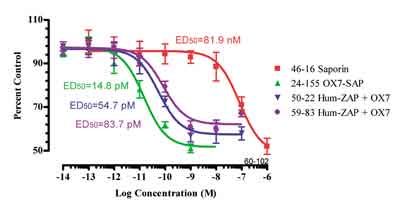
A: Start with a few animals and do dose-ranging as discussed in the previous question. The various modes of application are really too wide to discuss in any detail here, but I, a biochemist by training, always like the approach of thinking about what sort of concentration will be needed to have a cytotoxic effect. Generally, these molecules have an ED50 in the nanomolar to picomolar range. Obviously if you inject systemically, the material from the first becomes greatly diluted, relative to an injection directly into tissue, and so you’ll need a lot more. If you inject directly into tissue the local concentration can be quite high.

See: Targeted Toxins, Control Conjugates

Shopping Cart
Scroll to Top