Young EE, Baumbauer KM, Hillyer JE, Patterson AM, Hoy KC, Jr., Mintz EM, Joynes RL (2008) The neonatal injury-induced spinal learning deficit in adult rats: central mechanisms. Behav Neurosci 122:589-600. doi: 10.1037/0735-7044.122.3.589
Summary: This report examined whether neonatal injuries had any contralateral effects in adult life, and evaluated the role of the NK1 receptor of adult animals that had been subjected to neonatal trauma. Rats were injected with 5 µl of SP-SAP (Cat. #IT-07, 30 ng/µl, 100 ng/µl, or 300 ng/µl) into the intrathecal space. Blank-SAP (Cat. #IT-21) was used as a control. The results indicate both that injury effects are isolated in the injured limb, and NK1 receptor-expressing cells are involved in processing this pain.
Nattie E, Li A (2009) Central chemoreception is a complex system function that involves multiple brain stem sites. J Appl Physiol 106:1464-1466. doi: 10.1152/japplphysiol.00112.2008
Summary: This short review discusses central chemoreception and the different neuronal subtypes that play roles in this process. The use of anti-SERT-SAP (Cat. #IT-23) and anti-DBH-SAP (Cat. #IT-03) is mentioned in the context of how the loss of each of these cell types affects CO2 response in rats.
Laalou FZ, de Vasconcelos AP, Oberling P, Jeltsch H, Cassel JC, Pain L (2008) Involvement of the basal cholinergic forebrain in the mediation of general (propofol) anesthesia. Anesthesiology 108:888-896. doi: 10.1097/ALN.0b013e31816d919b
Summary: The authors examined whether the basal forebrain cholinergic system is involved in mediating the effects of general anesthesia. Three different forms of 192-IgG-SAP (Cat. #IT-01) administration were used: intracerebroventricular injection of 2 µg, 0.4 µg injected into the nucleus basalis magnocellularis, and 0.8 µg into the medial septum/vertical diagonal band of Broca. The results suggest that loss of cholinergic neurons in the cortex and hippocampus leads to potentiation of the anesthetic effects of Propofol.
Craig LA, Hong NS, Kopp J, McDonald RJ (2008) Emergence of spatial impairment in rats following specific cholinergic depletion of the medial septum combined with chronic stress. Eur J Neurosci 27:2262-2271. doi: 10.1111/j.1460-9568.2008.06179.x
Summary: Although it is clear that loss of cholinergic neurons in the basal forebrain is intrinsic to Alzheimer’s disease, interaction of this loss with other factors in causing the disease symptoms has not been completely elucidated. Rats received bilateral injections of 192-IgG-SAP (Cat. #IT-01) into the medial septum and vertical limb of the diagonal band of Broca totaling 0.075 µg. Lesioned animals were not impaired in a water maze task, but lesioning combined with stress caused a significant reduction in performance.
Harati H, Barbelivien A, Cosquer B, Majchrzak M, Cassel JC (2008) Selective cholinergic lesions in the rat nucleus basalis magnocellularis with limited damage in the medial septum specifically alter attention performance in the five-choice serial reaction time task. Neuroscience 153:72-83. doi: 10.1016/j.neuroscience.2008.01.031
Summary: The cognitive deficits reported in rats on use of 192-IgG-SAP (Cat. #IT-01) are varied. Here the authors examined the effect of lesions in the nucleus basalis magnocellularis (NBM) when septal damage was kept to a minimum. The NBM received bilateral 0.2-µg injections of 192-IgG-SAP, and the animals were then tested in a 5-choice serial reaction time task. The disruption of sustained visual attention remained, but other variables such as motivational, locomotion, and impulsivity-related biases were close to normal.
McGaughy J, Ross RS, Eichenbaum H (2008) Noradrenergic, but not cholinergic, deafferentation of prefrontal cortex impairs attentional set-shifting. Neuroscience 153:63-71. doi: 10.1016/j.neuroscience.2008.01.064
Summary: Norepinephrine and acetylcholine are involved in the mediation of attention, however, it is not yet clear whether the roles of these molecules are unique. This work utilizes a specific task shown to dissociate the roles played by the dorsolateral prefrontal cortex and the orbitofrontal cortex in primates. Rats received 5-ng infusions of anti-DBH-SAP (Cat. #IT-03) or 192-IgG-SAP (Cat. #IT-01) into each hemisphere. The type of lesion had an effect on attentional shifts and reaction to irrelevant stimuli.
Rahman W, Suzuki R, Hunt SP, Dickenson AH (2008) Selective ablation of dorsal horn NK(1) expressing cells reveals a modulation of spinal alpha2-adrenergic inhibition of dorsal horn neurones. Neuropharmacology 54:1208-1214. doi: 10.1016/j.neuropharm.2008.03.014
Summary: In this work the spinal origin of the major descending noradrenergic inhibitory pathway is examined with the help of SP-SAP (Cat. #IT-07). Rats received a 10-µl infusion of 1-mM SP-SAP (saporin, Cat. #PR-01, was used as a control) into the sub-arachnoid space terminating in the L4-5 region. Results from examining neuronal responses under the influence of the alpha2-adrenoceptor antagonist atipamezole suggest that NK1 expressing cells are involved with activity in noradrenergic pathways and descending facilitation.
One of the tests you can use to test your targeting agent for internalization is the in vitro Cytotoxicity Assay. Protocols to assist in preparing for, executing and interpreting results are now posted on our website.
There are several protocols available.
Preparing for a Cytotoxicity Assay using Secondary Conjugates. This protocol will be helpful when using our secondary antibody-saporin conjugates with your primary antibody. These include Anti-M-ZAP (Cat. #IT-30), Goat-ZAP (Cat. #IT-36), Hum-ZAP (Cat. #IT-22), Mab-ZAP (Cat. #IT-04), Rab-ZAP (Cat. #IT-05), and Rat-ZAP (Cat. #IT-26).
Preparing for a Cytotoxicity Assay using Streptavidin-ZAP. This protocol will be helpful when using our streptavidin-saporin conjugate (Streptavidin-ZAP, Cat. #IT-27) with your biotinylated targeting agent (peptide, ligand, cytokine, growth factor, antibody, etc.).
Concentration Calculation: Convert molarity to mg/ml and mg/ml to molarity. This protocol will help in determining the correct amount of material to use in your assay. There is also a link to an Online Calculator.
Cytotoxicity Assay for Targeted Toxins in vitro. This protocol includes photos of what your plates should look like during the assay process. It takes five days to complete this assay. Start on a Monday and develop on Friday. There are many factors that go into a successful cytotoxicity assay. This protocol should help you design and execute appropriately.
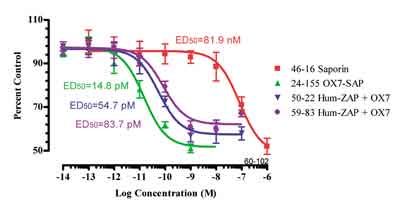
Preparing Cytotoxicity Data. This protocol will give an example of how to process the data from a Cytotoxicity Assay. ATS uses SOFTMax Pro software connected to a plate reader to determine the A490 value. Then we import this data into Prism software (GraphPad) to conduct further data analysis. Here is a figure generated with Prism.
We hope these protocols will be helpful to you in your research. If there are additional protocols or tutorials we can provide, please do not hesitate to ask.
This graph gives important information about how the potency of your targeted toxin. The ED50 is the Median Effective Dose (produces desired effect in 50% percent of population). The lower this number is, the more potent the targeted toxin.
Moreau PH, Cosquer B, Jeltsch H, Cassel JC, Mathis C (2008) Featured Article: Selective lesion of basal forebrain cholinergic neurons in mice with the mu p75-saporin immunotoxin: Neuroanatomy and behavior. Targeting Trends 9(2)
Wiley RG (2008) Substance P receptor-expressing dorsal horn neurons: Lessons from the targeted cytotoxin, substance P-saporin. Pain 136:7-10. doi: 10.1016/j.pain.2008.03.010
Summary: This review covers some of the more recent work utilizing SP-SAP (Cat. #IT-07) and SSP-SAP (Cat. #IT-11) in the dorsal horn. Specific answers to experimental questions are discussed, as well as some of the questions generated by the research. The potential of SP-SAP and SSP-SAP as pain therapeutics is also explored, along with potential clinical applications of other targeted toxins in pain therapy.