Yaksh TL, dos Santo G, Lemes J, Malange K (2023) Neuraxial drug delivery in pain management: An overview of past, present, and future. Anaesthesiology doi: 10.1016/j.bpa.2023.04.003
Objective: Activation of neuraxial nociceptive linkages leads to a high level of encoding of the message that is transmitted to the brain and that can initiate a pain state with its attendant emotive covariates. The authors review the encoding of this message and describe the how it is subject to regulation by pharmacological targeting of dorsal root ganglion and dorsal horn systems.
Summary: Authors provide an overview of the past, present and future directions of the biology, pharmacology and technology relevant to the use of the neuraxial route. SP-SAP was used as a neuraxial toxin to eliminate NK1R expressing cells, which characteristic of neurons known to be the second order neurons responding to C fiber input. Delivery of SP-SAP results in long-lasting loss of NK1 bearing dorsal horn neurons and analgesia.
Puente BR (2021) Chronic pain in dogs (Dolor crónico en el perro). Zaragoza Spain: Gruppo Asis Biomedia, S. L..
Summary: The author presents a thorough overview of aspects of canine chronic pain. He includes SP-SAP (Substance P-Saporin) as an experimental drug, “its use as an adjuvant analgesic in dogs with bone cancer has been studied,”
Vetter I (2018) Toxins in Neurobiology: New tools from old molecules. Neurosci Lett 679:1-3. doi: 10.1016/j.neulet.2018.05.008
Summary: The selective ablation of neurokinin-1 receptor-expressing neurons by SP-SAP revealed a key role for the preBötzinger complex in the generation of respiratory rhythm. Toxin-mediated neuronal ablation may also find therapeutic applications, such as the treatment of severe refractory pain in terminally ill patients by intrathecal SP-SAP which causes selective loss of neurokinin-1 receptor-expressing neurons in the spinal cord dorsal horn.
Over the years, ATS has frequently been asked about Saporin’s safety for use in the lab as well as when used clinically. Residual awareness of alternate Ribosome-Inactivating Proteins (RIPs) and ‘toxins’ such as Ricin have caused some researchers new to the use of RIPs to question the belief that Saporin is safe. Unlike Type 2 RIPs (such as Ricin), Type I RIPs, like Saporin have no binding chain and consequently no means of entering the physiological space necessary for the protein to act as a toxin. The following is a review of safety in handling and potential toxicity within the human body for systemic events not related to normal research applications of Saporin conjugates, including Substance P-Saporin (SP-SAP), which is a therapeutic under development for the treatment of chronic pain.
The acute LD50 for saporin in mice (25 g) is 6.8 mg/kg;[1] that would translate in humans (75 kg) to 510 mg! A concentration of about 100 nM is the threshold to see even a vague hint of saporin toxicity. In human blood, that would correspond to 24 mg injected systemically into a person. The fermentation process to produce recombinant saporin has a titer of 2 mg/L meaning that the production broth itself contains no more than 67 nM concentration of saporin. Furthermore, the final protein concentrations from production batches of recombinant Saporin used in our drug are 4 mg/ml, meaning 6 mL of final material would need to accidentally end up in a human before the ‘hint of toxicity’ threshold would potentially be met.
The toxicology studies of SP-SAP contained within ATS’s IND prior to the current human Phase I clinical trial evaluated effects related to the intended method of administration, intrathecal local injection. SP-SAP is not expected to ever be a self-administered therapy, so the effects of gross off-target events, such as accidental auto-injection, swallowing, spillage, or immersion were not considered.
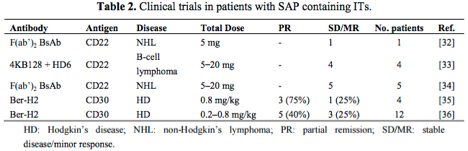
The table below[2] highlights antibody-saporin conjugates approved by the FDA for Phase I/II clinical trials in humans. The therapeutics listed below were administered intravenously and imply what the FDA accepted as non-toxic levels of saporin-based conjugates in these studies.
Looking more closely at the study by French et al.,[3] several milligrams of antibody conjugate were repeatedly injected into human patients under a FDA regulated clinical trial and peak serum levels tested, demonstrating rapid clearing of saporin from the system.
As a company that specializes in Saporin, our two-plus decades of experience working with the protein in research, preclinical, and clinical environments has taught us that with minimal standard laboratory precautions users are not at any real risk of toxic effects. Even our CSO, after 30+ years of working with Saporin exhibits undetectable levels of Saporin antibodies in his blood!
Pergolizzi J, Gharibo C, Ho K (2015) Treatment considerations for cancer pain: A global perspective. Pain Pract 15:778-792. doi: 10.1111/papr.12253
Summary: This review discusses the treatment of cancer pain, addressing various aspects of the overall picture, such as early pain treatment to reduce central sensitization and chronic pain, pain assessment tools, and guidelines for treating specific populations of patients. Some of the current tools for pain management are discussed, including SP-SAP, which is currently in clinical trials as a cancer pain therapeutic.
Frankel AE, Nymeyer H, Lappi DA, Higgins D, Ahn C, Noe C (2014) Preliminary results from a phase I study of substance P-saporin in terminal cancer patients with intractable pain. Journal of Clinical Oncology 32:191. doi: 10.1200/jco.2014.32.31_suppl.191
Summary: Existing pain therapies are insufficient to control cancer pain in 10-15% of patients. Substance P (SP) and its receptor, neurokinin-1 (NK-1r) have been determined to play a major role in spinal transmission of chronic pain. Animal studies have demonstrated that disruption of the NK-1r pathway alleviates chronic pain caused by a variety of stimuli. The authors are conducting a Phase I clinical trial in humans (NCT02036281) assessing the ability of SP-SAP (Cat. #IT-07) to treat intractable chronic pain due to cancer. Patients have received intrathecal injections of 1, 2, or 4 µg of SP-SAP with no evidence of toxicity or neurological or cardiac abnormalities. Doses will escalate up to 90 µg.
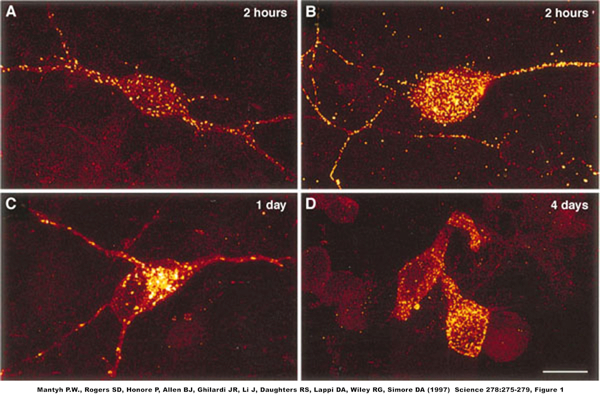
Q: How long does it take to see the cell death occurring from the use of targeted toxins using saporin? Is there a time course of hours or days?
A: The figure below illustrates the time course of cell death very effectively. Internalization and cytotoxicity of SP-SAP in primary cultures of neonatal spinal cord neurons. Confocal image of neurons where the Substance P receptor; NK1R (SPR) immunofluorescence (A, C, D) appears red, areas of concentrated SPR immunofluorescence appear yellow. (A, C, and D) SPR immunofluorescence in neurons 2 hours, 1 day, and 4 days, respectively, after treatment with SP-SAP. (B) Confocal image showing SAP immunofluorescence (yellow) 2 hours after SP-SAP treatment.
These images were projected from 14 optical sections acquired at 0.8-mm intervals with a 603 lens. Bar, 25 mm.
It is recommended that you wait for two weeks to allow for all debris to be cleared and the animal to regain normal eating and sleeping habits.
Wiese AJ, Rathbun M, Butt MT, Malkmus SA, Richter PJ, Osborn KG, Xu Q, Veesart SL, Steinauer JJ, Higgins D, Lappi DA, Russell B, Yaksh TL (2013) Intrathecal substance p-saporin in the dog: distribution, safety, and spinal neurokinin-1 receptor ablation. Anesthesiology 119(5):1163-1177. doi: 10.1097/ALN.0b013e3182a95164
Summary: Here the authors investigate the safety parameters of SP-SAP on purpose-bred beagles (currently in human clinical trials). The dogs received 1.5, 15, or 150 μg intrathecal injections of the conjugate. SP-SAP pharmacology and physiological effects were assessed by behavioral and functional observations, immunohistochemistry, ELISA, blood and urine analysis, histopathology, and in situ hybridization. The general conclusions include that neurokinin-1 receptor (NK1r) positive neuron loss is detectable as soon as 7 days after administration of SP-SAP, the neuron loss is permanent, toxicity is specific to NK1r-positive neurons, and, other than the 150 μg dose, NK1r neuron loss was restricted to the superficial dorsal horn.
Brown DC, Agnello K (2013) Intrathecal substance p-saporin in the dog: efficacy in bone cancer pain. Anesthesiology 119(5):1178-1185. doi: 10.1097/ALN.0b013e3182a95188
Summary: This work demonstrates the use of naturally occurring bone cancer in dogs as a model for pain therapy. Companion dogs with bone cancer received 20-60 μg intrathecal injections of SP-SAP (currently in human clinical trials) depending on the size of the dog. Significantly more dogs in the control group required unblinding and adjustment of pain care than in the SP-SAP group, indicating the efficacy of SP-SAP in pain control. This study also demonstrates the validity of the dog model for testing analgesic protocols.