Ngo M, Han A, Lakatos A, Sahoo D, Hachey S, Weiskopf K, Beck A, Weissman I, Boiko A (2016) Antibody therapy targeting CD47 and CD271 effectively suppresses melanoma metastasis in patient-derived xenografts. Cell Rep 16:1701-1716. doi: 10.1016/j.celrep.2016.07.004
Summary: The high rate of metastasis and recurrence among melanoma patients indicates the presence of cells within melanoma that have the ability to both initiate metastatic programs and bypass immune recognition. The authors identified CD47 as a regulator of melanoma tumor metastasis and immune evasion. The study involved antibody-mediated blockade of CD47 coupled with targeting of CD271+ melanoma cells by way of ME20.4-SAP (Cat. #IT-15). Mice bearing human melanoma tumor (M213 or M727) were randomized into four treatment groups with one of those groups receiving treatment with ME20.4-SAP. 1 ug in 50 ul volumes were injected directly into the center mass of the tumor once every 2 days. A therapeutic effect was observed where tumor metastasis in patient-derived xenografts was strongly inhibited when treated with the combination of antibody-mediated blockade of CD47 and targeted with ME20.4-SAP.
Kumar J, Rajkumar R, Lee L, Dawe G (2016) Nucleus incertus contributes to an anxiogenic effect of buspirone in rats: Involvement of 5-HT1A receptors. Neuropharmacology 110:1-14. doi: 10.1016/j.neuropharm.2016.07.019
Summary: The nucleus incertus (NI) is involved in stress and anxiety responses. The NI is a cluster of GABAergic neurons in the brainstem, and coexpresses CRF, 5-HT1A and D2 receptors. Buspirone is a partial agonist of 5-HT1A receptors, an antagonist of D2 receptors, and activates the NI. Buspirone is an anti-anxiety drug, but preclinical studies showed that it induces anxiety at high doses. To see if the NI is necessary for the anxiogenic effects of high doses of buspirone, rats were bilaterally injected with 86 ng of CRF-SAP (Cat. #IT-13) into the NI. Blank-SAP (Cat. #IT-21) was used as a control. NI lesioning alone had an anxiogenic effect in several anxiety screening tests compared to sham-lesioned rats, which suggests that the NI reduces anxiety physiologically. Lesioning with CRF-SAP reduced the anxiogenic effects of intra-NI injections of buspirone. No significant difference in the anxiety screening tests resulted from injecting quinpiole, a D2 agonist, which suggests that the 5HT1A receptors in the NI are involved in the anxiogenic effects of buspirone.
Gilabert-Oriol R, Thakur M, Haussmann K, Niesler N, Bhargava C, Görick C, Fuchs H, Weng A (2016) Saponins from Saponaria officinalis L. augment the efficacy of a Rituximab-immunotoxin. Planta Med 82:1525-1531. doi: 10.1055/s-0042-110495
Summary: It is known that triterpenoidal saponins that come from Saponaria officinalis, the plant that saporin comes from, increases the cytotoxicity of saporin by modulating its intracellular trafficking. Investigators wanted to know if this could increase the therapeutic affect of Rituximab-Saporin. In the presence of saponins, Rituximab-Saporin had a 700-fold increase in efficacy. Concentrations of 0.0001-1nM of Anti-CD22-SAP (Cat. #IT-37) and 0.001-10nM of Anti-CD25-SAP (Cat. #IT-24) were also tested in vitro with saponins for comparison. They saw a 170-fold and 25-fold increase in cytotoxicity, respectively. All conjugates were tested on Ramos cells, and differing levels of receptor expression could explain the drastic differences in cytotoxicity enhancement.
Matsuura T, Kawasaki M, Hashimoto H, Yoshimura M, Motojima Y, Saito R, Ueno H, Maruyama T, Ishikura T, Sabanai K, Mori T, Ohnishi H, Onaka T, Sakai A, Ueta Y (2016) Possible involvement of the rat hypothalamo-neurohypophysial/-spinal oxytocinergic pathways in acute nociceptive responses. J Neuroendocrinol 28(6) doi: 10.1111/jne.12396
Summary: It has been suggested that the amplification of GABAergic neurons in the inhibitory system induces the selective inhibition by Oxytocin (OXT) of excitability in the spinal cord, and the pain transmitted from the periphery to the dorsal horn of the spinal cord by this action may be attenuated at the spinal cord level. Rats were injected IT with Oxytocin-SAP (Cat. #IT-46) dissolved in saline (0.06 μg/μl), Blank-SAP (Cat. #IT-21) dissolved in saline (0.06 μg/μl), or saline. Formalin-induced acute nociception activated OXT-containing cells in both the magnocellular and parvocellular divisions of hypothalamus, and that the parvocellular division remains activated longer than the magnocellular division. Acute nociception-induced activation of the hypothalamo-neurohypophysial system caused elevation of plasma OXT levels. In addition, the OXTergic spinal pathway may be involved in pain modulation via OXTRs in the spinal cord.
Mohammed M, Kulasekara K, Ootsuka Y, Blessing W (2016) Locus coeruleus noradrenergic innervation of the amygdala facilitates alerting-induced constriction of the rat tail artery. Am J Physiol Regul Integr Comp Physiol 310:R1109-1119. doi: 10.1152/ajpregu.00058.2016
Summary: The researchers tested the hypothesis that release of noradrenaline within the amygdala is important for the occurrence of SCVARS (sympathetic cutaneous vasoconstrictor alerting responses). A long-shanked 5-μl glass micropipette calibrated in 100-nl steps, was filled with vehicle or Anti-DBH-SAP (Cat. #IT-03). Anti-DBH-SAP (5 μg in 250 nl) or vehicle was injected into the amygdala during ∼1 min, and the pipette was left in place for an additional The locus coeruleus has been implicated in many aspects of emotional arousal, so that functional inhibition of the extensive locus coeruleus-derived noradrenergic innervation of centers known to be important in emotional arousal, including the amygdala, is likely to contribute to the therapeutic actions of clonidine-like agents. The locus coeruleus also has major reciprocal connections with the orexin-synthesizing neurons in the hypothalamus, and rats with genetically lesioned orexin receptor neurons (alternatively, oen could lesion with Orexin-SAP, Cat. #IT-20) have reduced emotional arousal as reflected in reduced SCVAR responses to alerting stimuli.
Dickey D, Thomas G, Dassie J, Giangrande P (2016) Method for confirming cytoplaintratumoral anti-HuD immunotoxinsmic delivery of RNA aptamers. (eds. Shum K, Rossi J). In: SiRNA Delivery Methods. Methods in Molecular Biology. 1364:209-217. Humana Press, New York, NY. doi: 10.1007/978-1-4939-3112-5_17
Objective: To describe a functional assay (RIP assay) to confirm cellular uptake and subsequent cytoplasmic release of an RNA aptamer which binds to a cell surface receptor expressed on prostate cancer cells (PSMA).
Summary: This publication details an in vitro functional assay to confirm that the aptamer retains function following conjugation to saporin and describe a cellular assay to measure aptamer-mediated saporin-induced cytotoxicity.
Usage: The folded biotinylated aptamer was mixed at a 1:4 molar ratio of Streptavidin-ZAP, confirmed by agarose gel, a PSMA enzymatic activity (NAALADase) assay performed. FGF-SAP was used as a control.
Matsuura T, Kawasaki M, Hashimoto H, Yoshimura M, Motojima Y, Saito R, Ueno H, Maruyama T, Sabanai K, Mori T, Ohnishi H, Sakai A, Ueta Y (2016) Effects of central administration of oxytocin-saporin cytotoxin on chronic inflammation and feeding/drinking behaviors in adjuvant arthritic rats. Neurosci Lett 621:104-110. doi: 10.1016/j.neulet.2016.04.010
Summary: In the present study, Oxytocin-SAP, which chemically disrupts oxytocin (OXT signaling was administered centrally and an OXT receptor (OXTR) antagonist administered peripherally to determine whether central and peripheral OXT is involved in chronic inflammation and feeding/drinking behavior in adjuvant arthritis (AA) rats. Rats were injected i.t. with Oxytocin-SAP (Cat. #IT-46) or Blank-SAP (Cat. #IT-21) dissolved in saline (0.06 μg/μl). The results demonstrated that the arthritis index values were significantly enhanced and suppression of food intake was transiently attenuated in Oxytocin-SAP treated rats when AA developed, The arthritis index and food intake did not significantly change in the OXTR antagonist i.p.-injected rats. These results suggest that central oxytocinergic pathways may be involved in anti-inflammation at the spinal level and suppression of feeding behavior at the forebrain-brainstem level in AA rats.
Angioni L, Cocco C, Ferri G, Argiolas A, Melis M, Sanna F (2016) Involvement of nigral oxytocin in locomotor activity: A behavioral, immunohistochemical and lesion study in male rats. Horm Behav 83:23-38. doi: 10.1016/j.yhbeh.2016.05.012
Summary: Oxytocin is well known for its hormonal role in lactation and parturition, but also exerts widespread actions in central nervous system. Previous experiments revealed the existence of a correlation between the changes in locomotor activity found in Oxytocin-SAP-treated rats and the extent of the changes in nigral TH and vesicular glutamate transporters immunoreactivity, provide support for a modulatory role of oxytocin on locomotor activity at the level of the substantia nigra. The day after a prior assessment of spontaneous locomotor activity, rats were randomly injected bilaterally with 0.3 μL of Oxytocin-SAP (Cat. #IT-46, 60 ng/μL/site), or with the same amount of Blank-SAP (Cat. #IT-21, 60 ng/μL/site) or with vehicle (0.3 μL/site of PBS, pH 7.4). Whether oxytocin may be considered as a target for controlling motor disturbances, as those occurring in Parkinson’s disease and/or in other motor disturbances related to basal ganglia dysfunctions, remains to be evaluated
Lee S, Diener K, Kaufman S, Krieger J, Pettersen K, Jejelava N, Arnold M, Watts A, Langhans W (2016) Limiting glucocorticoid secretion increases the anorexigenic property of Exendin-4. Mol Metab 5:552-565. doi: 10.1016/j.molmet.2016.04.008
Summary: Glucagon-like peptide-1 (GLP-1) analogs lower blood surgar levels and cause a loss of appetite. Exendin-4 (Ex-4) is a GLP-1 receptor agonist, and also increases glucocorticoid secretion. Several tests were conducted to determine if the released glucocorticoids interact with Ex-4’s anorexigneic effect. One method involved ablating hindbrain catecholaminergic neurons by stereotaxically injecting 42 ng of Anti-DBH-SAP (Cat. #IT-03) bilaterally into the paraventricular nucleus of the hypothalamus in rats. Animals were injected with equimolar concentrations of unconjugated Saporin (Cat. #PR-01) as a control. Anti-DBH-SAP lesions reduced the efficacy of Ex-4 to increase corticosterone secretion but increased the anorexigenic effect, indicating that Ex-4-dependent corticosterone secretion opposes Ex-4’s actions. Anti-DBH-SAP lesions increased Ex-4’s ability to reduce food intake and body weight.
Over the years, ATS has frequently been asked about Saporin’s safety for use in the lab as well as when used clinically. Residual awareness of alternate Ribosome-Inactivating Proteins (RIPs) and ‘toxins’ such as Ricin have caused some researchers new to the use of RIPs to question the belief that Saporin is safe. Unlike Type 2 RIPs (such as Ricin), Type I RIPs, like Saporin have no binding chain and consequently no means of entering the physiological space necessary for the protein to act as a toxin. The following is a review of safety in handling and potential toxicity within the human body for systemic events not related to normal research applications of Saporin conjugates, including Substance P-Saporin (SP-SAP), which is a therapeutic under development for the treatment of chronic pain.
The acute LD50 for saporin in mice (25 g) is 6.8 mg/kg;[1] that would translate in humans (75 kg) to 510 mg! A concentration of about 100 nM is the threshold to see even a vague hint of saporin toxicity. In human blood, that would correspond to 24 mg injected systemically into a person. The fermentation process to produce recombinant saporin has a titer of 2 mg/L meaning that the production broth itself contains no more than 67 nM concentration of saporin. Furthermore, the final protein concentrations from production batches of recombinant Saporin used in our drug are 4 mg/ml, meaning 6 mL of final material would need to accidentally end up in a human before the ‘hint of toxicity’ threshold would potentially be met.
The toxicology studies of SP-SAP contained within ATS’s IND prior to the current human Phase I clinical trial evaluated effects related to the intended method of administration, intrathecal local injection. SP-SAP is not expected to ever be a self-administered therapy, so the effects of gross off-target events, such as accidental auto-injection, swallowing, spillage, or immersion were not considered.
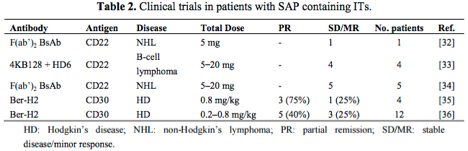
The table below[2] highlights antibody-saporin conjugates approved by the FDA for Phase I/II clinical trials in humans. The therapeutics listed below were administered intravenously and imply what the FDA accepted as non-toxic levels of saporin-based conjugates in these studies.
Looking more closely at the study by French et al.,[3] several milligrams of antibody conjugate were repeatedly injected into human patients under a FDA regulated clinical trial and peak serum levels tested, demonstrating rapid clearing of saporin from the system.
As a company that specializes in Saporin, our two-plus decades of experience working with the protein in research, preclinical, and clinical environments has taught us that with minimal standard laboratory precautions users are not at any real risk of toxic effects. Even our CSO, after 30+ years of working with Saporin exhibits undetectable levels of Saporin antibodies in his blood!