
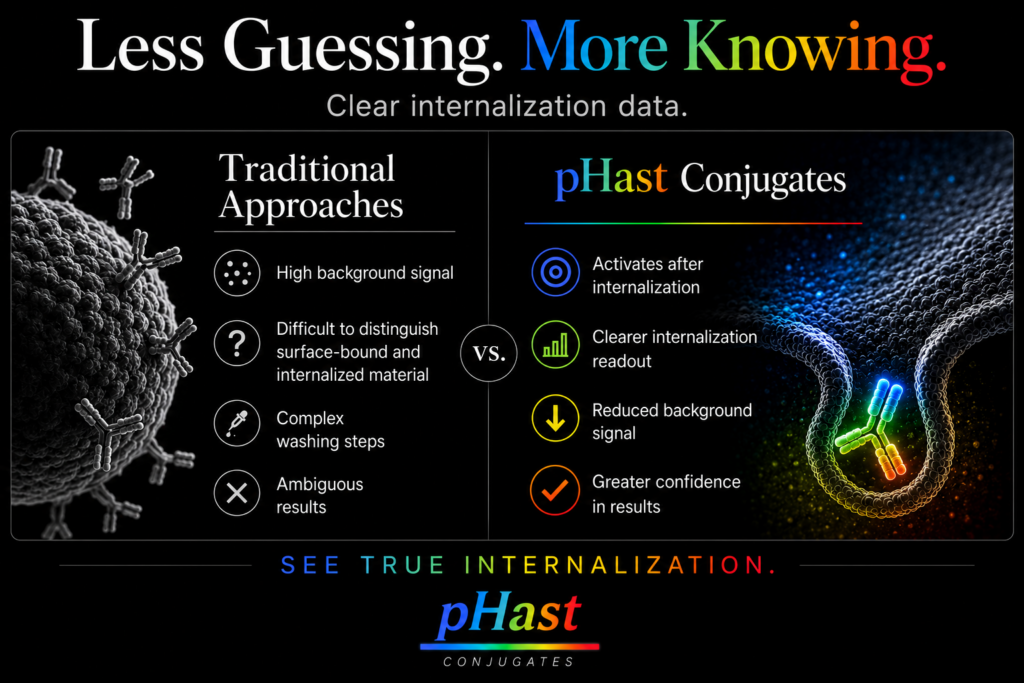
Less Guessing. More Knowing.
Determining whether a targeting material truly internalizes can be one of the biggest challenges in early-stage evaluation. Binding alone does not guarantee internalization, and traditional fluorescent assays often create more uncertainty than clarity. Surface-bound signal, background fluorescence, and complex wash steps can all make it difficult to know which candidates are actually entering cells.
pHast Conjugates were designed to solve that problem.
Using a pH-sensitive fluorescent reporter, pHast remains silent at neutral pH and activates only after internalization into acidic intracellular compartments. The result is a direct, biologically relevant readout of true internalization with low background and a simpler workflow.
In this video, ATS scientists Leonardo Ancheta and Patrick Shramm walk through the internalization challenge, how pHast works, and why it can help accelerate candidate evaluation across a wide range of targeting materials and assay platforms.
Traditional Approaches: High background signal; Difficult to distinguish surface-bound and internalized material; Complex washing steps; Ambiguous results. pHast Conjugate Approach: Activates after internalization; Clearer internalization readout; Reduced background signal; Greater confidence in results